
Surrendering
Friday, Jun 5, 2026
The achievement virus is endemic to American life. Most of us are carriers.
Reading Time: About 15 minutes
I.
When do you surrender?
This was the question occupying my mind as I sat on the platform with my faculty colleagues at our school’s commencement ceremony for the Class of 2026. In front of me was legendary football coach, Pete Carroll, advising every individual in the crowd to adopt a personal philosophy. His was: always compete.
As you might expect, there was no talk of surrender from Coach Carroll. I would imagine that few of the graduates were thinking about this either. But listening to his advice, I realized that I couldn’t put into words what my own life philosophy was. Did I even have one?
What finally surfaced was a sentence I have repeated to myself for decades:
If I’m not getting better, I’m getting worse.
For as long as I can remember, I’ve been striving toward something, never fully satisfied with what I had already accomplished. It is a mentality that has cost me thousands of dollars in therapy. During my most recent stint on the couch, after I recited this familiar mantra, my therapist asked me that annoying question: when do you surrender?
What?
Surrendering has never crossed my mind. It is antithetical to how I was raised and how I have tried to live my life. I’ve also been fortunate to live an upwardly mobile life that is, at least in part, the result of an endless hunger to achieve, and yes, compete. I’m not a quitter.
So when do I surrender?
When I’m dead, that’s when.
The therapist suggested that surrendering and giving up are not the same thing. Over time, I have recognized the subtle differences. Giving up is to quit. Too hard, I’m out. But surrendering doesn’t have to mean defeat, nor does it have to mean resignation. Not every battle can be won, and there are definitely winnable battles that probably shouldn’t be attempted.
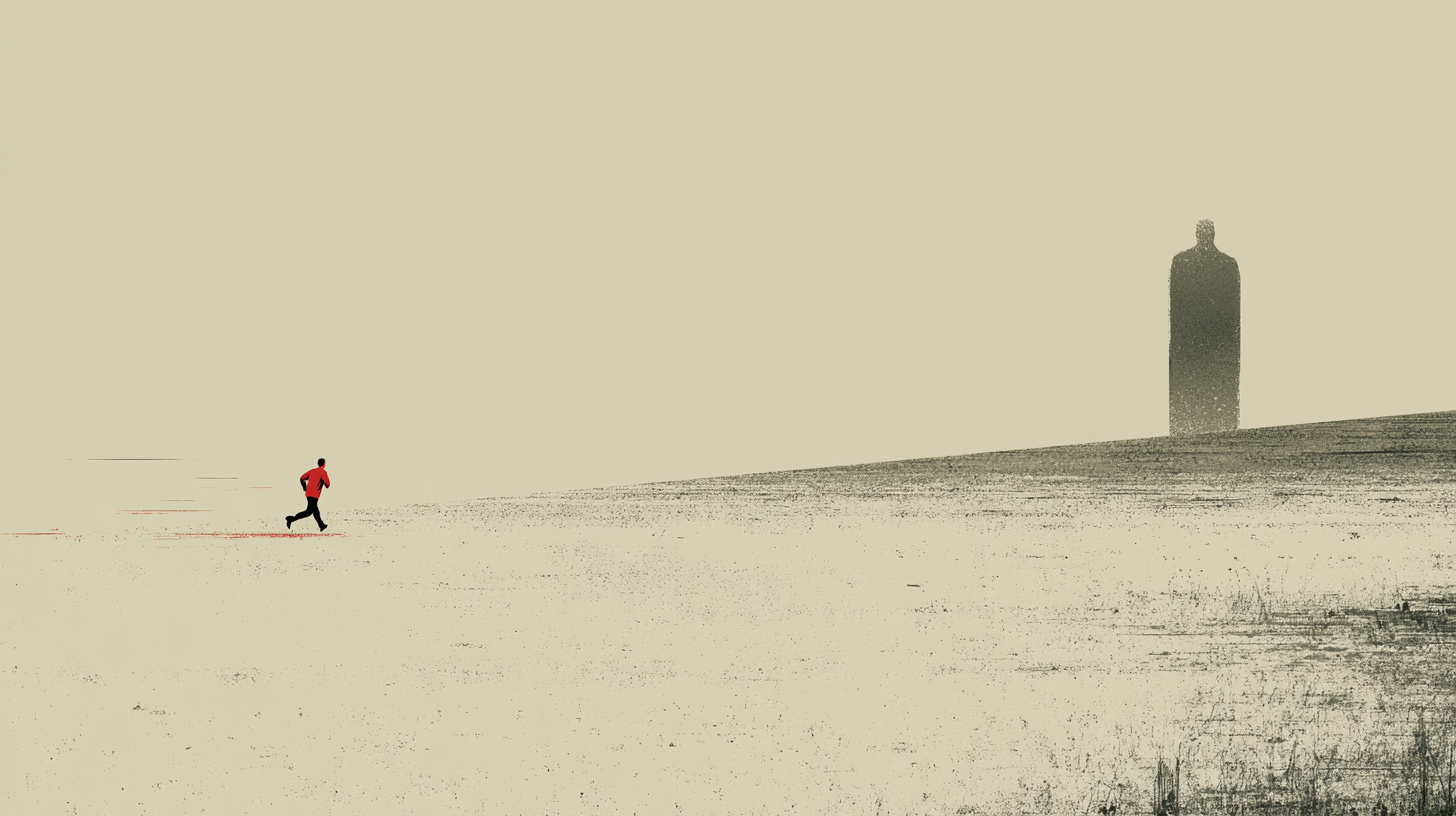
All of us are susceptible to the achievement virus—a proclivity to prove we can, at any cost. But it runs deeper than a desire to be our competitive best. It is a restless belief that with enough discipline, smarts, and effort, one can overcome life’s limitations.
I suspected that underneath the caps on the thousands of heads seated before me, more than a few were, like me, afflicted with this contagion. This is one of the most accomplished cohorts in modern history. They have set records in academic achievement and extracurricular involvement. They have also endured more disruption than most generations encounter before adulthood, including a global pandemic, wars abroad, and an unstable political climate.
There was enough grit in that audience that I suspected Coach Carroll’s message would feel not only inspiring, but intuitively true. For those afflicted with the virus, it might even lead them to ignore some sobering facts.
Unemployment among recent graduates has reached 5.6 percent, well above the rate for college graduates overall. Entry-level jobs are increasingly difficult to secure. AI, which arrived during their freshman year and helped them complete their assignments, is now threatening to shut them out of the career opportunities they came to college to compete for. They’ve been told AI will be their copilot, but many of them worry it will hijack their dreams.
Will more effort, discipline, or intelligence help them compete? Are they competing for the same prize that brought them here in the first place? What happens if they win?
II.
Nearly 60 years ago, the world was introduced to Benjamin Braddock, the hero of Mike Nichols’ Academy Award-winning film, The Graduate. Braddock is a textbook example of someone afflicted with the achievement virus. He has done everything right, and made everyone proud. Yet he feels adrift.
At his graduation party, he receives a piece of career advice that has become one of the most famous lines in American cinema:
“Plastics.”
The advice answers a vocational question—where the opportunities are—but not the existential one that troubles Benjamin most: what am I doing with my life?
It’s true that this question has probably dwelled in the minds of every graduate, regardless of generation. But it may have resonated more with Baby Boomers in 1967 because the world was riddled with conflicts and contradictions. They were awakening to the realization that the roadmap they had dutifully followed might be leading them to destinations they didn’t care to visit, like a career in plastics.
Today’s graduates face similar conclusions. They were taught that “data” and STEM-focused career paths would be the tickets to their success. Now, AI can outperform them on many of the skills they’ve learned. Like Benjamin Braddock, they are justified in asking what they should do with their lives now.
This tension may explain why commencement speakers who attempted to reassure graduates about AI encountered resistance. At the University of Arizona, former Google chief executive Eric Schmidt was booed as he acknowledged what many graduates already feared:
There is a fear in your generation that the future has already been written, that the machines are coming, that the jobs are evaporating, that the climate is breaking, that politics is fractured, and that you are inheriting a mess that you did not create…
The line was intended as empathy. It landed, in part, as a life sentence.
Graduates are worrying about much more than whether AI will transform their world. They are worrying that they may have spent two decades preparing for a world that no longer exists. Higher education is built upon a premise that your future is a function of your achievement. But the system equates futures with careers. The trouble is that careers answer only one of the questions that make a life meaningful. For those stricken by the achievement virus (and universities are hot zones for it), that context is easily lost.
III.
To tell Sigmund Freud he might be a little too preoccupied with his penis was bold enough. To do so as a woman in the early days of the twentieth century took balls.
Karen Horney had both the credentials and the courage to challenge the father of psychoanalysis. Where Freud saw libido lurking beneath nearly every human motivation, Horney believed anxiety was the true culprit. She became particularly interested in people who could not stop striving or comparing themselves to unrealistic standards.
Once the idealized self is established, people stop asking who they really are and start demanding that they become who they think they should be. They become plagued by perfectionism, starved for status, and driven towards relentless productivity. Their idealized self stands on the horizon, while their real self spends a lifetime running toward it.
Horney’s work suggests that achievement is a form of rent. The payment is never enough to own the property. You’re just buying a little more time before the next bill arrives. For those with the achievement virus, the bill comes quick. Each new accomplishment gets discounted a little more and the next one becomes that much more important. In this context, the challenge is releasing the obligation to become an imagined (and often impossible) version of ourselves.
A few decades later, the British pediatrician and psychoanalyst Donald Winnicott arrived at a similar conclusion, but he was interested in a different aspect of it: authenticity. He developed a concept he called the “false self” that aligns with Shakespeare’s observation that “all the world’s a stage and all the men and women merely players.” In life, each of us learns to play certain parts. We adopt the behaviors and identities that get rewarded and ignore or reject the ones that don’t. This behavior, in itself, is not pathological. It’s normal.
Winnicott’s concern was the potential for slippage. The version of ourselves that performs well in front of an audience is effective. But effectiveness and authenticity are not the same thing. The mask delivers the outcome. It does not deliver the self. And over enough years, the mask can become so familiar that we mistake it for who we actually are.
The achievement virus sits in between these two pathologies. The idealized self sets the bar too high, and the false self that is most effective at reaching it is the one we trust. Whether we rely on one or both, everything appears to be working to the outside world. We are living the dream. For proof, scroll my Instagram feed or LinkedIn profile. But inside, something feels hollow because neither self is real. Great for the therapy industry. Not so great for a well-functioning society.
IV.
Three corrections in one class. Each of them accurate. On the third one, something inside me collapsed.
The absurd part is that I was having a psychological breakdown at SoulCycle.
Let me make it weirder for you.
Gina Meyers, the instructor, is a dear friend. I trust her implicitly. She has proven time and time again how much she cares for her riders. I have been the beneficiary of generous coffee chats and loving insights that have helped me navigate many of life’s unexpected byroads.
Still not sold on how absurd this situation is?
I have explicitly asked Gina to call me out in class when she thinks I can do more, or when my form needs correcting.
So, why did three corrections from a friend I trust crush my soul?
Horney would say it’s because I am striving towards an idealized image of myself that is good enough to ride the podium. When real life delivers feedback that challenges that ideal self, the dissonance is crippling. Winnicott would say that a false self has proven so effective at improving my physical fitness that I have mistaken it for my authentic self. Trust me. I am no athlete. Neither diagnosis fully explains why I felt defeated in that moment. Maybe it has something to do with my characterization of the achievement virus itself.
A virus is invasive and contagious. It spreads. But the achievement virus feels more like an addiction than it does a disease. Addictions sustain themselves. When you’re not achieving—worse, when it feels like you’re regressing or failing—the withdrawal is debilitating. Perhaps the achievement virus is contagious at the cultural level and addictive at the personal level.
I genuinely love riding on a bike that goes nowhere, dancing to music that makes me want to push past my limits. That’s really why I’ve been riding several times a week, every single week, for more than 11 years.
But I chose the word virus for a reason.
On the days when Gina doesn’t teach, I often hop on a bike at my gym and do a 45 minute ride to a playlist of my own design. I give myself drills and try to master things I struggled with in class. I discovered that I could stay on the beat of a particularly challenging song that bedeviled me during one of her recent rides. It puzzled me so much that I texted her afterwards and asked why I could do it in one place but not another.
Her reply: stop caring.
She wasn’t being cheeky, and anyone who knows her knows she wasn’t suggesting I reduce my effort. Instead, she was suggesting I reframe the question.
V.
Around the same time commencement speeches were echoing across college campuses, an important question was being decided for two titans of achievement in a Silicon Valley courtroom. Elon Musk and Sam Altman were embroiled in a legal battle with the potential to shape two of the largest public offerings in history, and perhaps the future of artificial intelligence itself. Beneath the case were the usual suspects: money, ego, and power. I wasn’t there, but I can promise you there was no talk of surrendering.
There rarely is. Silicon Valley is filled with stories of extraordinary achievement. Founders sleep under their desks. Engineers work impossible hours. Executives speak loftily about changing the world. The OpenAI saga takes the pattern to an extreme: brilliant people convinced that the future depends upon their willingness to push harder, move faster, and seize control before someone else does.
The Valley’s unofficial patron saint is Marcus Aurelius. His Meditations sits on the bookshelves of offices all along Sand Hill Road, and insiders are particularly fond of one quote attributed to him:
You have power over your mind—not outside events. Realize this, and you will find strength.
Whether Aurelius wrote it or not is debated and almost beside the point. Silicon Valley has embraced it because it affirms a worldview that aligns with their addiction to achievement and control. The irony is that many of the quote’s devotees seem far more interested in the power it grants than in the limits it imposes. Meditations was not written as a field guide for future emperors. It was a personal diary, never intended to be published. In it, Marcus Aurelius spent much of his time arguing against the very instincts that feed the achievement virus. He writes endlessly about mortality, impermanence, humility, and limits.
Few people ever acquire enough power to test such a philosophy. One of the men who did exited the world stage right around the same time that the OpenAI trial was nearing its conclusion.
I suppose it’s curious to offer Ted Turner as a case example on the topic of surrendering. The “Mouth of the South” was not known for humility or restraint. His version of “always compete” could be extreme. During a sailing race, he once rammed the boat of his first wife, Judy Nye, to keep her from beating him.
He was not a man who liked to lose.
Which presents a puzzle, because at several important moments in his life, Ted Turner surrendered anyway.
To appreciate the significance of those moments, do not forget the scale of his ambitions. He spent much of his adult life trying to bend entire industries to his will—transforming a struggling Atlanta television station into a national superstation, launching CNN despite widespread skepticism, and amassing one of the largest media empires of the century. He won the America’s Cup. He became the largest private landowner in the country. Turner rarely encountered a mountain he did not want to climb, an opponent he did not want to beat, or a horizon he did not want to own. Classic symptoms of the achievement virus.
But his later life decisions make him an interesting study in relinquishing control. He began giving away wealth, limiting what could be done with land he owned, and investing in institutions whose benefits would largely accrue to future generations. The man who once seemed determined to conquer every horizon gradually became interested in stewardship. He didn’t stop caring. He reframed the question.
VI.
Last week, the riders in Gina’s class and I received an email from SoulCycle that our studio was closing after 13 years. It was devastating news. When my classmates and I regrouped for the first class after it dropped, few of us had dry eyes. I was also forced to reframe my question about why I ride.
In that reflection, I understood why Gina advised me to stop caring about what I could or couldn’t do on the bike. I ride because it’s fun. Because it keeps me healthy. Because, no matter how great the playlist I design for myself, it is never as good as the ones I enjoy with my chosen family. In that room, we’ve celebrated births, marriages, and new jobs. We’ve also comforted each other during times of uncertainty and unspeakable loss. Preserving this community matters far more than landing on the right foot at 230 beats per minute.
If I succumbed to the virus, I would lose sight of this. My training sessions in the gym would suffice.
In this context, and with commencement still fresh in my mind, I was reminded of when I entered business school to get my MBA back in 1995. I was required to take a battery of assessments that were designed to help me develop my leadership capabilities. One measured “locus of control.” After answering a series of questions, I was assessed on how much I was governed by an external or internal locus of control. I scored as far right as the scale allowed, which prompted the professor to summon me to his office hour.
He said he was concerned about me. He wanted me to understand that, no matter how much effort and intention I exert, some things were beyond my control. I found this unsettling. I didn’t like being labelled a control freak. I assured him I didn’t have a savior complex. I was more likely to blame myself for things that went wrong than I was to take credit for the things that went right. He nodded and said that that was precisely why he was worried. “Some things in business and in life,” he said, “happen because of dumb luck.”
Almost ten years later, those words would bring that lesson home. That was when my youngest daughter Jordan was diagnosed with brain cancer. Nothing prepares you for a cancer diagnosis. For someone with the achievement virus, the natural instinct is to make it about you.
One of the first questions I asked her oncologist was if anything in our environment was to blame. How did this happen? Was it her diet? Did we expose her to something harmful? This is the achiever’s mind trying to solve the riddle.
His reply: No. This is pure dumb luck.
Not long after, I had a conversation with Jordan’s nurse care practitioner, an angel living on earth named Barbara Britt. I was in the midst of micro-managing the health care system to uncover the solutions they had obviously overlooked, and I asked for her advice.
She paused and then reminded me how special my daughter was, how much she made everyone laugh, how much bigger her spirit was than her tiny body, and how remarkable her will to fight was.
She didn’t need to say anything more.
The two of us just sat there silently, admiring Jordan while she napped.
And right there, I surrendered.
Not to the fight for Jordan’s life. I am happy to report she won that fight.
I surrendered to a different realization. No amount of intelligence, discipline, or determination was going to make me a better father in that moment. I simply needed to be present. The achievement virus wanted me to solve a problem. Barbara was coaxing me to reframe the question.
For years, I thought the challenge was how to get better. How to win. How to compete.
The real challenge is learning what deserves my effort in the first place. I’m still working on it.