
A Ghost of a Chance
Saturday, Mar 28, 2026
Nearly half of job seekers were ghosted by an employer last year. The psychology behind why reveals something most of us don't want to hear about ourselves.
Reading Time: About 17 minutes
I.
Counseling was never one of my career goals. I possess the toxic combo of being an Aries and a proud member of Generation X. My initial instinct when asked for career advice is to reply, “pull yourself together and figure it out.” Yet I am also the product of the Midwest, and my better angels counsel me to smile, listen, and try to help friends get ahead.
As it turns out, career counseling is a big part of the job when you’re a business school professor, especially when most of your career existed outside of the brick-lined walls of academia. My office hours with students tend to focus on paths to good jobs in marketing. Truthfully, I enjoy these discussions. I’m at an age when it is quite apparent to me how much potential my students have, how lucky employers would be to have them, and how blind they usually are to their own talents.
A few weeks ago, a former student scheduled a Zoom with me on my day off. She graduated a year ago and was still in the hunt. Since graduating, she had completed over 300 interviews. Many progressed to second and third rounds. One required eleven rounds. In too many cases, the end was disheartening if not insulting: complete silence.
She wanted to know what she should do when recruiters and hiring managers don’t answer their phones or respond to emails. She asked, “what am I doing wrong and what should I do next?”
She wasn’t doing anything wrong. If anything, she was doing everything right. Unlike many of her peers, she was getting interviews. I seriously doubted that the silence was due to her qualifications or her effort. She had smarts and grit (as evident by her tenacity in the face of countless interviews).
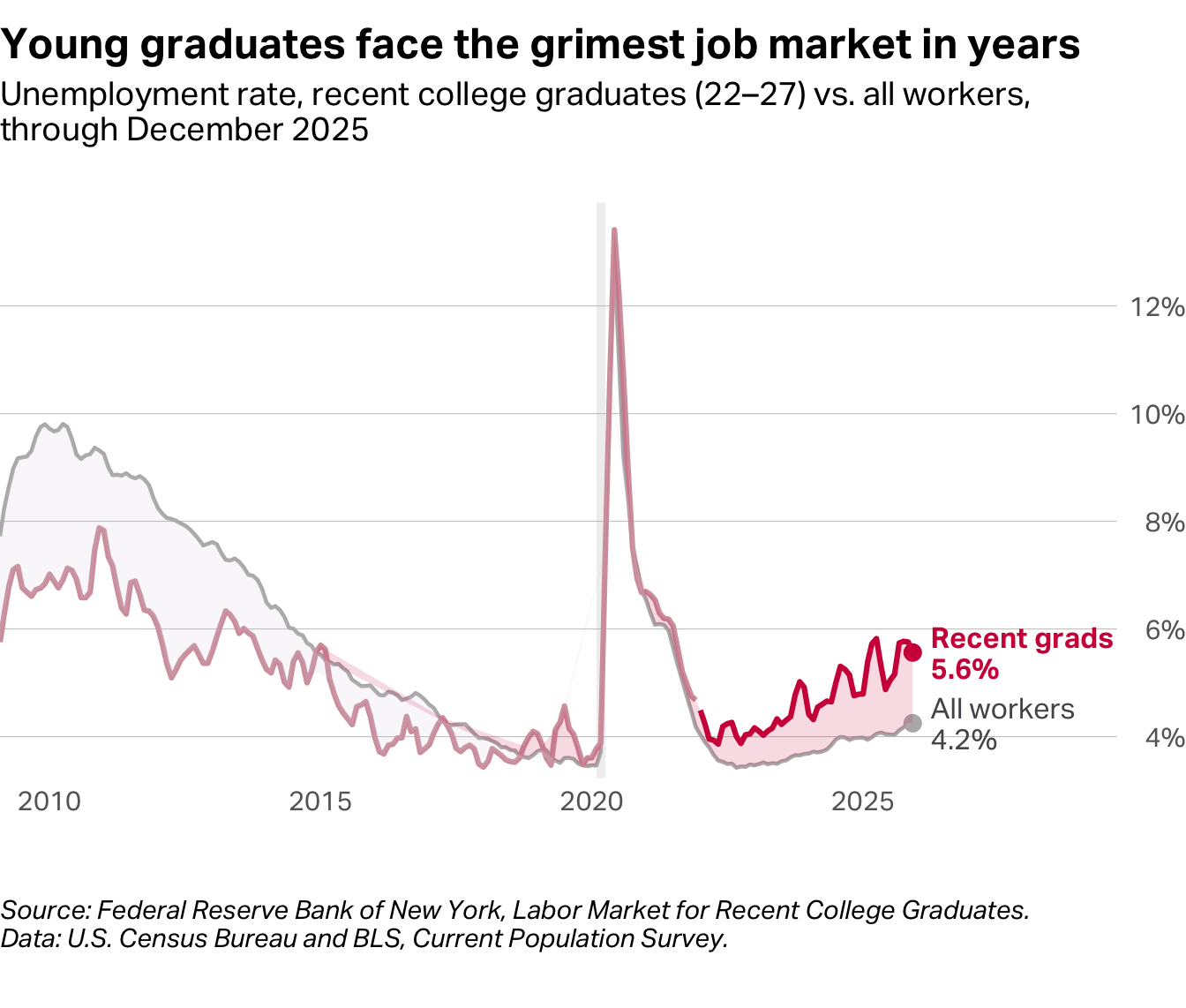
I told her the usual spiel. This is the worst hiring environment I’ve seen since I pivoted to teaching in 2021. Even in the days following The Great Recession, the unemployment rate for college graduates had been less than it was for the working population, as a whole. But after 2015 the lines started converging, creating a wobble in the market place for recent graduates. In some years people 22-27 began finding it harder to land a job than their older colleagues. After COVID, it wasn’t a wobble. It was a steady pattern. The gap increased year over year.
Matters have been made worse by AI’s disruption of knowledge work, the reshuffling of the global economic order under new tariffs, and financial markets that twitch at the price of oil and conflict in the Middle East, all while money managers cope with this eerie deja vu feeling that private credit is about to have a mortgage-backed securities moment. It is no wonder that management consensus at most American companies adheres to a mantra of Don’t hire. Don’t fire.
That’s all true, and it provides little solace. But there’s something more–something I didn’t tell her, because I was a little ashamed. I understood more about how she felt than I was letting on.
Last year was the leanest year I’ve experienced since launching my private practice. The majority of my client work stems from repeat clients, many of whom have worked with me for decades. They are more than valued clients and colleagues. Most are now dear friends. Yet for the majority of 2025, even my most casual, friendly efforts at outreach and connection went unanswered.
In the old days, it was simple. You picked up the phone. You’d time it right and catch them before voicemail. You’d have a conversation and gradually opportunities surfaced. But now no one answers their phone and it is just too easy to ignore an email.
I came close to throwing in the towel last year. More than close. I wondered whether my best days as a strategist and researcher were behind me, and whether the silence meant something I wasn’t ready to acknowledge.
A fourth quarter deluge of projects arrived before the holidays, some from the very clients I thought had abandoned me. The lights came back on but the darkness while they were out was unsettling, and sitting across from her on that Zoom, I recognized in my student’s face that she and I had seen the same specter in the void.
We were both being haunted. And neither of us knew why.
II.
The young man shifting in his chair had been deep in an online conversation with a new friend when the “spinning wheel of death” appeared, followed by an error message. The platform facilitating his conversation was experiencing technical difficulties. He waited patiently for a minute or two before the anxiety set deeper in. He’d met his chat partner just a few minutes before. Both were participants in a research project. They’d been discussing their favorite movies when the platform glitched. Now, with each additional minute passing, he wondered what the person on the other end was thinking. Were they seeing the same error message? Did they know that he couldn’t respond, or did they think he’d dropped off out of disinterest?
What he didn’t know was that this wasn’t a glitch. It was all part of the study–the brainchild of YeJin Park Roberts, a PhD candidate in Management and Organization at the NYU Stern School of Business.
Park’s work focuses on play and how it influences work relationships. She has proposed that play might be a lever to “rehumanize” aspects of work that lead to greater equity and flourishing business performance. She contends that play leads to connection and feelings of inclusion. She started researching play in a search for what happens when people are brought together. This study originated by considering the dark side of this search: what happens when they disappear?
She co-authored the results of the work with Nadav Klein in a 2024 paper titled, “Ghosting: Social rejection without explanation, but not without care.”, published in Journal of Experimental Psychology: General. In the study, they staged several experiments to understand ghosting. For Park, it was deeply personal. “As someone who has–and has been–ghosted frequently in my personal and professional relationships, this phenomena was something that had interested me for a while,” she said. “I was excited to explore a personal phenomena using a psychological vantage.” Our stressed out texter participated in one of these experiments, all part of a quest to understand the psychological dimensions that affect Ghosters and their Ghostees.
A few minutes after he encountered technical difficulties, the research team provided the man in the study with options. If he wanted to leave, the team would let him keep the money promised to him for the research, even though the experiment couldn’t be completed (or so he thought). They even offered to pay him a slight bonus as consideration for his troubles. But there was a twist. The researchers would let him apply the bonus to a separate text channel on the platform that would allow him to send an explanation to his new acquaintance, if he wanted. Or, he could wait 20-30 minutes for the technical difficulty to resolve, with no guarantee that his partner would still be on the other end.
The researchers gave him an easy out. It was a technical difficulty and not his fault at all. He could keep the money. Yet 44% of the time, people in his position elected to pay money not to ghost a stranger they’d known for only about 3 minutes.
While it may surprise you to imagine someone forfeiting a payday to convince a complete stranger they hadn’t ghosted them, the other side of the coin is equally revealing. Ghostees assumed the worst and significantly underestimated the intentions and feelings of the Ghoster. This pattern repeated across every method Park and Klein employed.
In a separate series of experiments, they asked real people to recall actual ghosting experiences from their own lives. They found that the average relationship that ended in ghosting had lasted for five years. Five years. What’s remarkable is the asymmetry of perception that resulted from the ghosting. The person left in the silence dramatically underestimated how much the person who had gone quiet actually cared about them. Ghostees predicted that Ghosters cared about their wellbeing at roughly a two on a seven-point scale. Ghosters reported their actual care closer to a four. This repeated across every experiment, every method, and every culture the researchers tested.
The reason for this asymmetry was something more complicated than negligence or indifference. Ghosters reported other-oriented motives. In more than a third of the accounts, Ghosters said they didn’t want to hurt the other person. They didn’t want them to feel rejected. Meanwhile, Ghostees believed those same motives to be true of the people who had ghosted them less than fifteen percent of the time. To the Ghostee, the silence proves that they didn’t matter enough. The data reveals something more humbling.
What if the silence has nothing to do with how much they wish you would disappear? What if (and the research makes this uncomfortable to dismiss) they ghosted you because they value you more than you even knew?
III.
Over the years, I have repeatedly shared a piece of advice I received many years ago, sitting in a classroom taught by legendary HBS professor Tom DeLong. One should assume that all ambiguous information will be interpreted negatively. When you’re ghosted, the intuitive conclusion is that the person on the other end doesn’t care about you. Yet that doesn’t square with Park and Klein’s experiments.
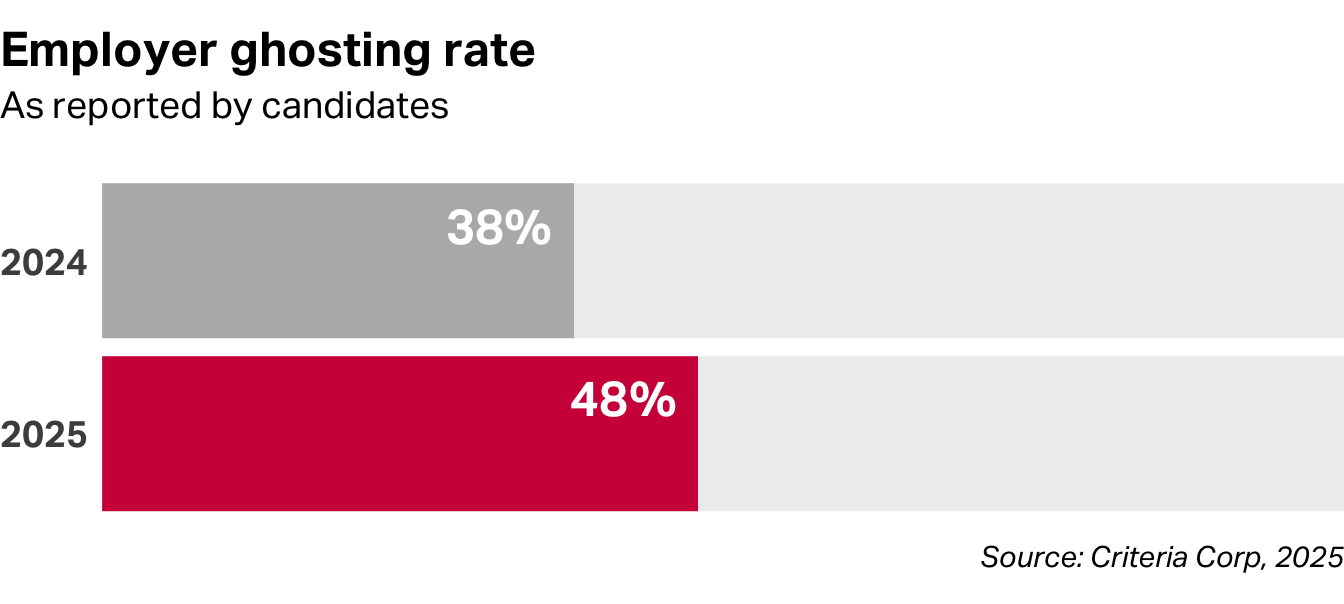
Whatever the psychology at play with the Ghoster, employers appear to be more inclined to play that role than they were in the past. A recent study by Criteria Corp, a provider of employee testing and video interviewing tools that also publishes an annual Candidate Experience Report, found that almost half of candidates claim they were ghosted by employers. That’s up from 38% the year before.
Candidates are not innocent. Data from The Great Resignation period of 2022-2023 suggests that there was an epidemic of ghosting by job-seekers when the labor market was dealing with a supply shortage. A colleague of mine said at the time, “you call them back for a final interview and they no-show. You have to line up three or four, hoping that one will show up.” It seems more logical to conclude that both sides believe turnabout is fair play, and that neither trusts the other. America has had a conflicted relationship with both concepts for quite some time.
The General Social Survey has asked Americans a series of the same questions about each other since 1972. One of those questions is simply, “Can most people be trusted?” Fifty years ago, 46% of Americans said yes. Today, only 24% think so. A second question asked, “do you think most people try to be fair?” Again, half a century ago 59% said yes. Today, it’s 42%.
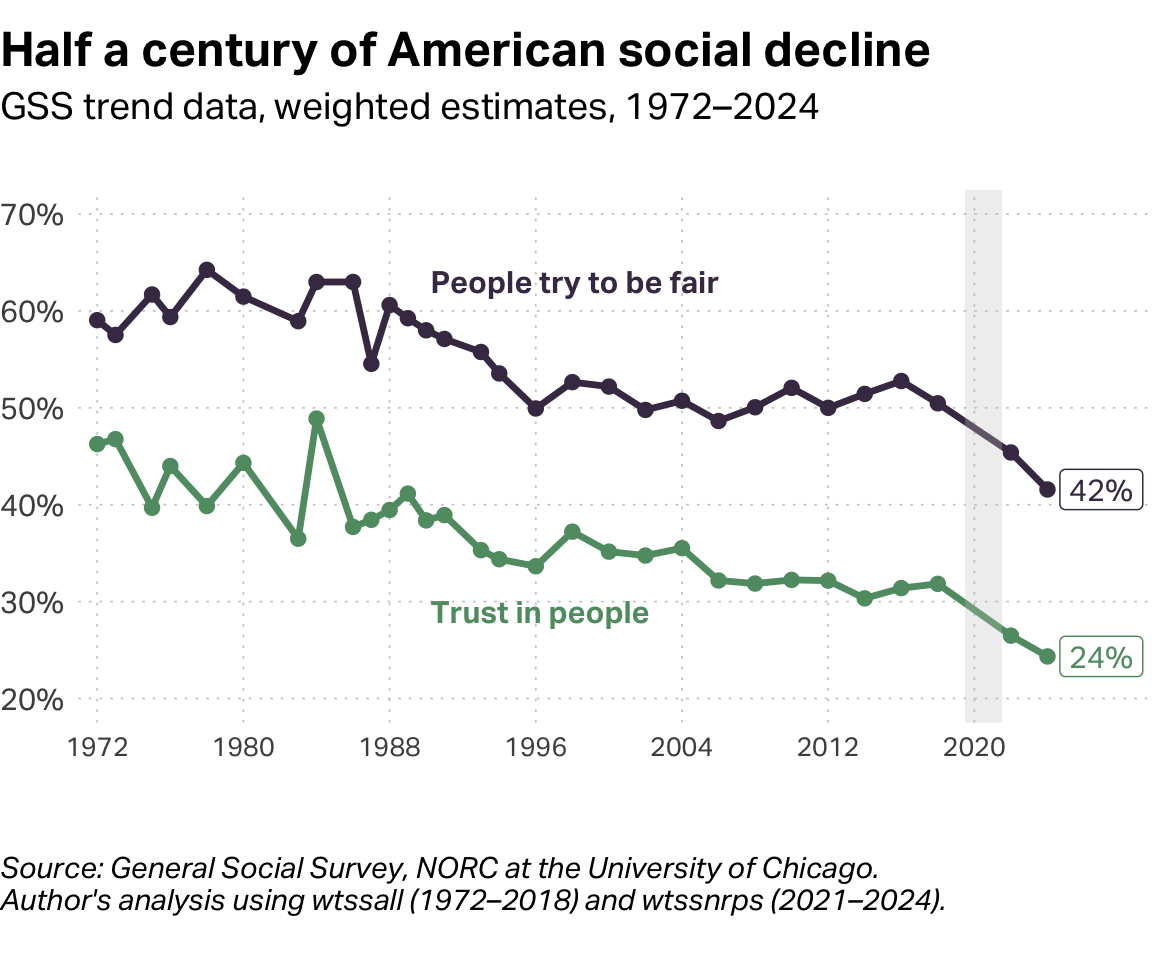
These are the operating assumptions people carry into every unanswered email, every ignored follow-up, every silence that stretches past the point of reasonable explanation. Ghosting did not create this mistrust or skepticism. Perhaps it grew out of it.
It also doesn’t help that we are socializing a lot less. The Bureau of Labor Statistics has tracked how Americans spend their time since 2003. Back then, 38% of Americans socialized on an average day. When that metric was last measured, in 2024, the percentage was 29%. Americans spend 158 fewer hours a year in face-to-face social contact than they did two decades ago. The pandemic certainly accelerated the decline, but the trendline was declining before we locked down.
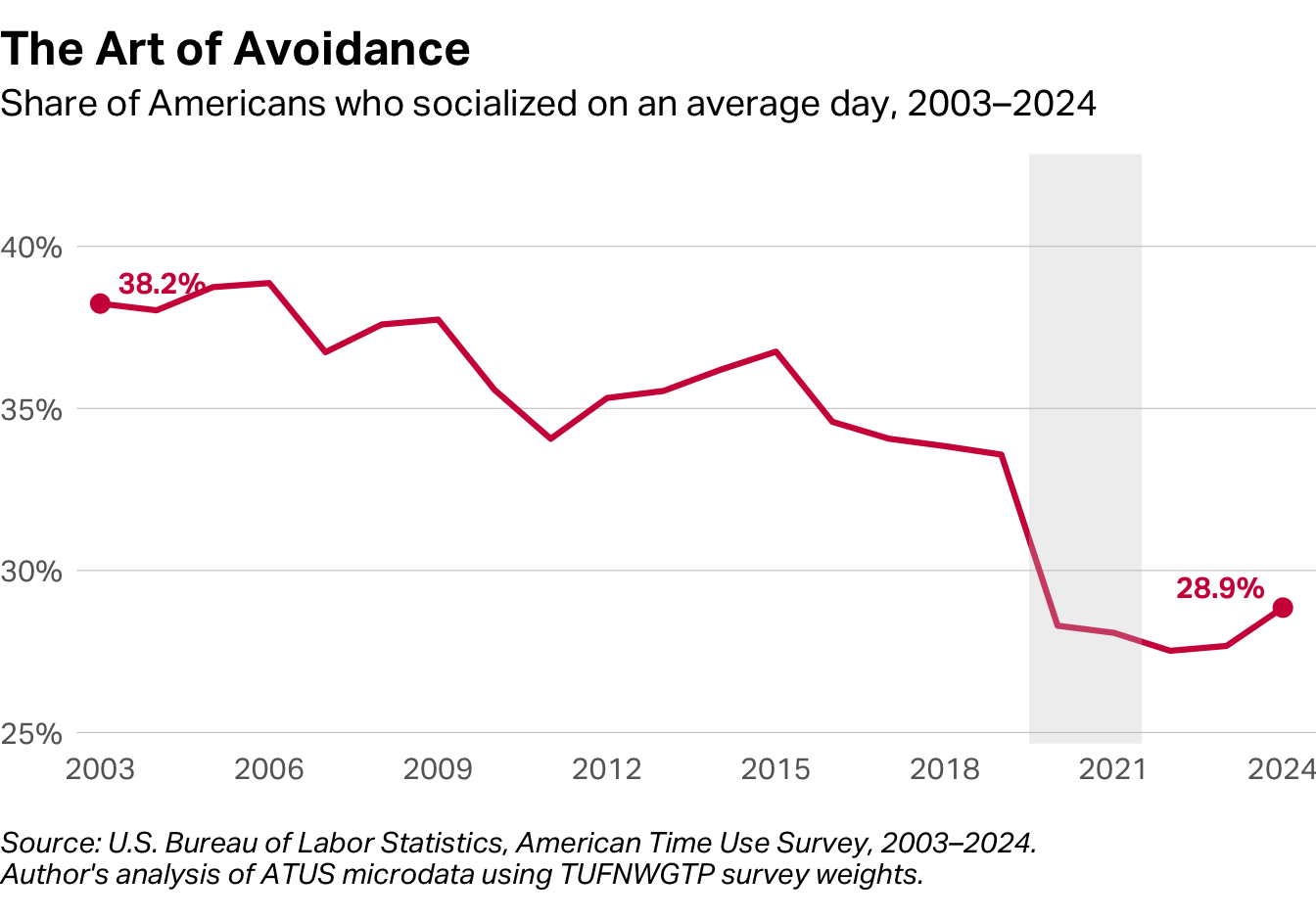
Did we stop socializing because we grew increasingly convinced people are unfair and not to be trusted, or did we stop trusting and believing in fairness because we withdrew from social activities? I don’t know. That’s above my pay-grade. But it does seem a self-fulfilling prophecy. And it doesn’t change the fact that a lot of folks are feeling hurt from ghosting.
I complained about this several months ago over lunch with a friend who was once my client. She’s a New Yorker and she possesses that absolutely wonderful filterless quality that never leaves you guessing what she really thinks. After ranting about being ghosted by a long-term client, I served up a dose of virtue-signalling by saying that when I was the client, I made it a point to get back to my suppliers. It was never fun to say, “I don’t have anything,” but it was the right thing to do.
She looked me straight in the eyes and said, “Larry, have you checked the news? The world is a dumpster fire.” I countered that was no excuse. And she replied, “you have no idea what the person on the other end of the line is going through at this moment.”
I’d been so caught up in my own frustration and feelings of abandonment that it hadn’t occurred to me that the perpetrator might be in a worse mental state than I was. The data certainly supports this proposition.
The American Psychological Association surveyed more than 3,000 adults in the summer of 2025 and found that 69% had needed more emotional support over the past year than they received. That figure has climbed every year since 2023. Nearly seven in ten employed adults identified work as a significant source of personal stress, the highest reading since the first months of COVID.
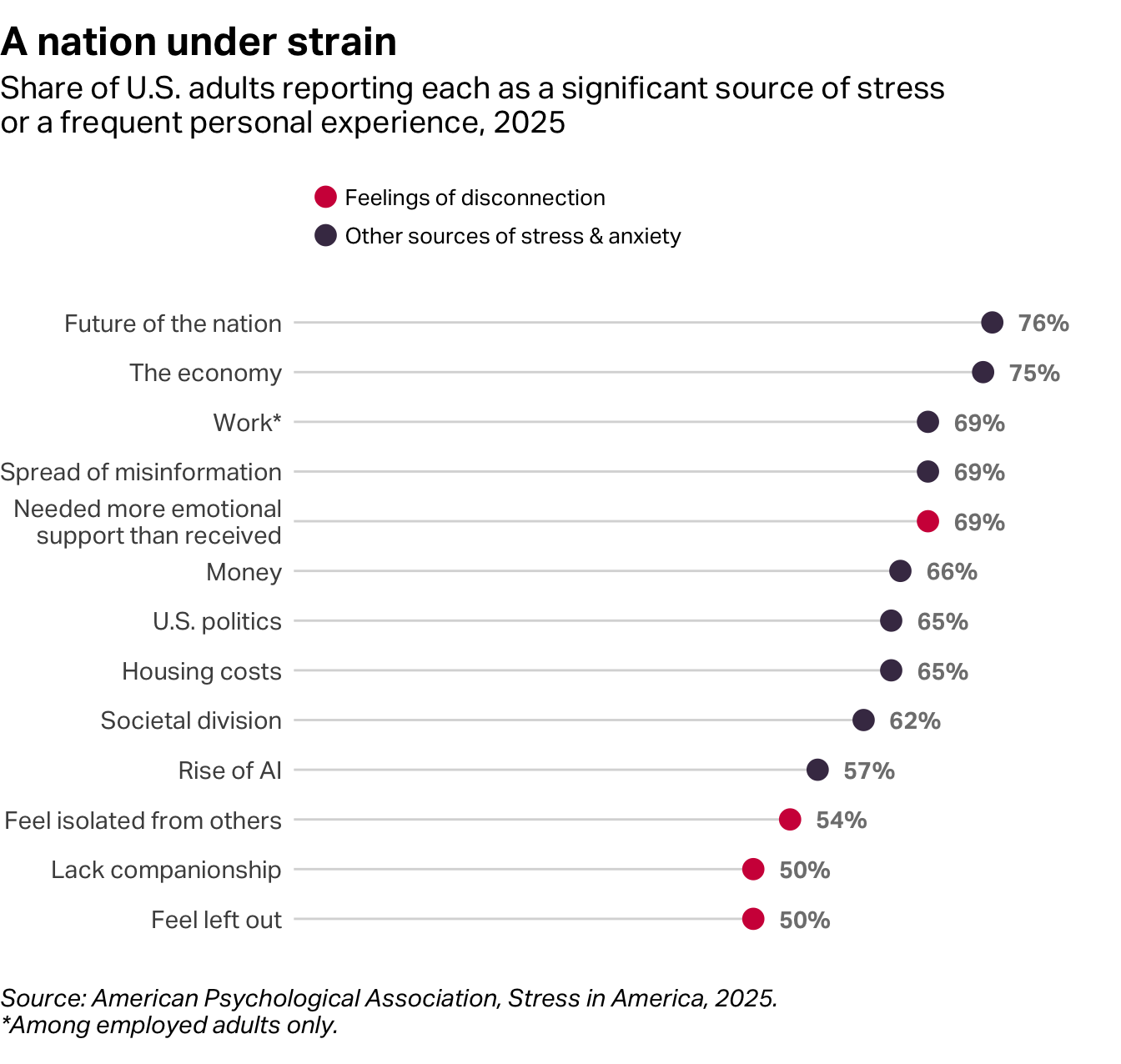
The saddest dimension of their data are all the statistics that point to a lot of us feeling disconnected. 54% say they feel isolated from others. Half say they feel left out. Is it any wonder that we believe the worst when the person on the other end of the line disappears? For all we know, they are indeed experiencing the worst.
IV.
Brené Brown has spent her career studying what happens to people when they feel exposed. Her 2010 TED talk on vulnerability became one of the most watched in the history of the platform. She struck a nerve because she was naming something people already knew but couldn’t articulate.
Brown differentiates between guilt and shame. Guilt says, “I did something wrong.” Shame says, “I am something wrong.” Guilt motivates repair. Most of us, when feeling guilty, want to take action.
Shame demands concealment.
When we feel ashamed, we often feel the need to withdraw. We no longer feel we belong or that we are welcome. There is a process at play that Brown has documented extensively. It begins when something goes wrong between two people. The failure itself can often be very small. You didn’t reply to an email. It’s trivial; recoverable. People get busy. Inboxes get full. These are ordinary human failures. They don’t have to end relationships.
Shame changes the physics of the situation. Once a person feels not just that they did something wrong but that they are something wrong–that they are careless, unworthy, cowardly, inadequate–the natural response is to hide. And hiding means not fixing the thing that created the shame in the first place. So the small failure sits there, unaddressed, accumulating weight. Days become weeks. The cost of re-entry rises. What started as a missed email becomes, in the mind of the person who missed it, evidence of their fundamental personal failure. They can’t fix it without confirming the verdict. So they don’t fix it.
For some, ghosting is nothing more than carelessness. But for others, it runs on shame.
When they didn’t respond to that email they started confirming what they believe the ghostee is thinking about them: that they are someone who abandons people who trusted them. So they stay quiet. The shame of the silence grows in direct proportion to its length. The longer it runs, the more it costs to break it. The exit, which was never locked, begins to feel like the only option.
Meanwhile, the ghostee waits and begins their own shame spiral. They check their phone. They repeatedly re-read the last message they sent, looking for the thing they said that drove the other person away. They either find it or invent it. The silence confirms what the shame whispered. They believe they are not worth responding to. Perhaps they believe that the relationship meant more to them than it did to the other person. They progressed from feeling wronged to worthless.
You have two people, progressing through two independent shame spirals, sustained by a shared silence on both ends.
One of my favorite jokes is to say that I finally resolved an argument I had with someone years ago in the shower today. I usually get a laugh because the experience is universal.The person that you’re imagining in that argument probably doesn’t remember it or didn’t feel what you assumed they did. We have a tendency to project our worst fears onto innocent conspirators.
Jean Twenge, a psychologist at San Diego State who has spent years interviewing teenagers about their social lives, noticed something that clarifies this. Many of the teenagers she spoke with were frustrated. They wanted to get together with friends in person. But they assumed their friends didn’t want to. She heard this from teenagers at the same school, in the same grade, so many times that she finally understood what was happening. They weren’t talking to each other about it. Each one had already decided the answer was no. So nobody reached out.
The assumption of rejection arrived before the rejection. The silence was mutual and self-generated. Nobody ghosted anybody. They just each decided, independently and invisibly, that the other person didn’t want to connect, and then behaved accordingly.
This is what Park and Klein’s research makes so uncomfortable to sit with. The ghostee who concludes they weren’t worth a response is almost certainly wrong. The ghoster who says nothing because they don’t want to cause pain is almost certainly causing more of it. Both are operating on assumptions the other person never made. Both are alone inside a narrative the other person never authored.
It brings us back to “the fondness paradox” Park and Klein’s research suggests, that the people most likely to ghost you may also be the ones who care about you most. It is not a comforting idea. It is a devastating one. It might mean that the silence you interpreted as indifference was the sound of someone who valued you so much they couldn’t figure out how to gracefully respond.
It raises a different question. We’ve established why we ghost. But what do we do about it?
V.
Christmas Eve, 1914 on The Western Front. The war is five months old and already nothing like anyone had promised or imagined. The trenches run for four hundred miles. The mud feels permanent. The dead are everywhere.
Then someone lights a candle.
A German soldier places a small tree on the edge of his trench and sets a candle on the branches. Another soldier joins him. Then another. The British watch from across no man’s land as the German line suddenly begins to glow. Someone sings Stille Nacht. And then a voice on the British side answers. Then more voices. Then someone climbs out of a trench without a weapon and walks into the frozen ground between the lines.
By morning they were exchanging cigarettes and showing each other photographs of their families. Rifleman Walkington described the German line as looking like an illuminated fête. A German soldier told his British counterpart, “we all have wives and children. We’re just the same kind of men as you are.”
Meanwhile, the generals were horrified. It was strictly against the rules. It was dangerous. And it changed nothing structurally. They were right. The war resumed on December 26th and did not end for four more years.
And yet.
No one ordered the tree, the candles, or the singing. No one waited for conditions to be perfect. No one knew if the gesture would be answered before they made it. One person decided the silence had gone on long enough and did the only thing available to them. They made themselves visible and hoped for the best.
Digital communication has removed the circuit breakers that used to make disappearing harder. You cannot ignore someone’s eye contact. You cannot pretend you didn’t hear a voice in the same room. But you can leave an email unread for a month and tell yourself you’ll get to it. The friction that once forced human contact has been engineered away, and we are lonelier for it.
The imperfect gesture is the candle on the trench line. It takes about thirty seconds. A quick email reply. I haven’t forgotten you. Things have been complicated. I’ll be in touch properly soon. It doesn’t resolve everything. It doesn’t have to. It just has to be sent.
My student on that Zoom had done nothing wrong. The silence was never a verdict on her worth. It was a weather system she got caught in; a structural and accelerating weather system that was indifferent to her qualifications or her effort. I told her to keep going, and I know she will because she has grit. I wish I could advise her on how to break the pattern. The best advice I gave was to not give up and to keep nudging those contacts. Whenever she does that, she might be lighting a candle. Her persistence and her nudges might give people on the other end of the silence permission to answer.
I believe that. The data, unexpectedly, agrees.